
✅ Truck Winch — Sizing And Top Picks
- Size rule: 1.5× truck GVWR. F-150 (7,500 lb) needs 11,250+ lb winch. F-250 (10,000 lb) needs 15,000+ lb.
- Top truck picks: Warn Zeon 12-S Platinum (premium), Warn VR EVO 12-S (value), Smittybilt X2O 12 GEN3 (budget).
- Bumper reinforcement matters. Factory truck bumpers rarely hold 12k+ winches. Aftermarket welded bumpers or frame-mount plates required.
- Alternator headroom: factory 140A is marginal. Upgrade to 220A+ for trucks that winch more than monthly.
- Receiver-mount option: 2″ Class III+ hitch + portable cradle = moves between vehicles, no permanent bumper mod.
Key Takeaways
- Start with your truck’s GVWR × 1.5 to size a truck winch, then bump up or down based on how loaded your truck runs, single-line vs double-line pulls, and the type of terrain you actually wheel.
- Series wound motors are the workhorses for heavy truck recovery and frequent pulls. Permanent magnet motors are fine for lighter trucks and occasional winch use if budget is tight.
- If you see mud, water crossings, or winter road slop, look for at least an IP67 rating and a realistic duty cycle spec, not just big marketing numbers.
- Bumper-mount winches are strongest and most stable. Hitch-mount setups let you move the winch but can trash your approach angle. Hidden mounts keep things looking stock but can choke cooling and make service a pain.
- Always wire the winch directly to the battery with correctly sized cables, fused within 18 inches of the positive post, and protected with loom and proper firewall grommets wherever wires pass through metal.
- Fitment is not one-size-fits-all. Ford F-150, Toyota Tacoma, Ford Bronco, and Chevrolet Silverado each have their own frame horn shapes, bumper bolt patterns, and winch tray quirks.
- Top 2026 picks like the Warn VR Evo 12 and Smittybilt X20-12000 hit a good balance of capacity, reliability, and cost for half-ton and mid-size trucks used in the real world.
- For dialed-in sizing and electrical checks, use tools like the truck winch capacity calculator and the truck winch amp draw specs guide before you spend money.
What Is a Truck Winch?
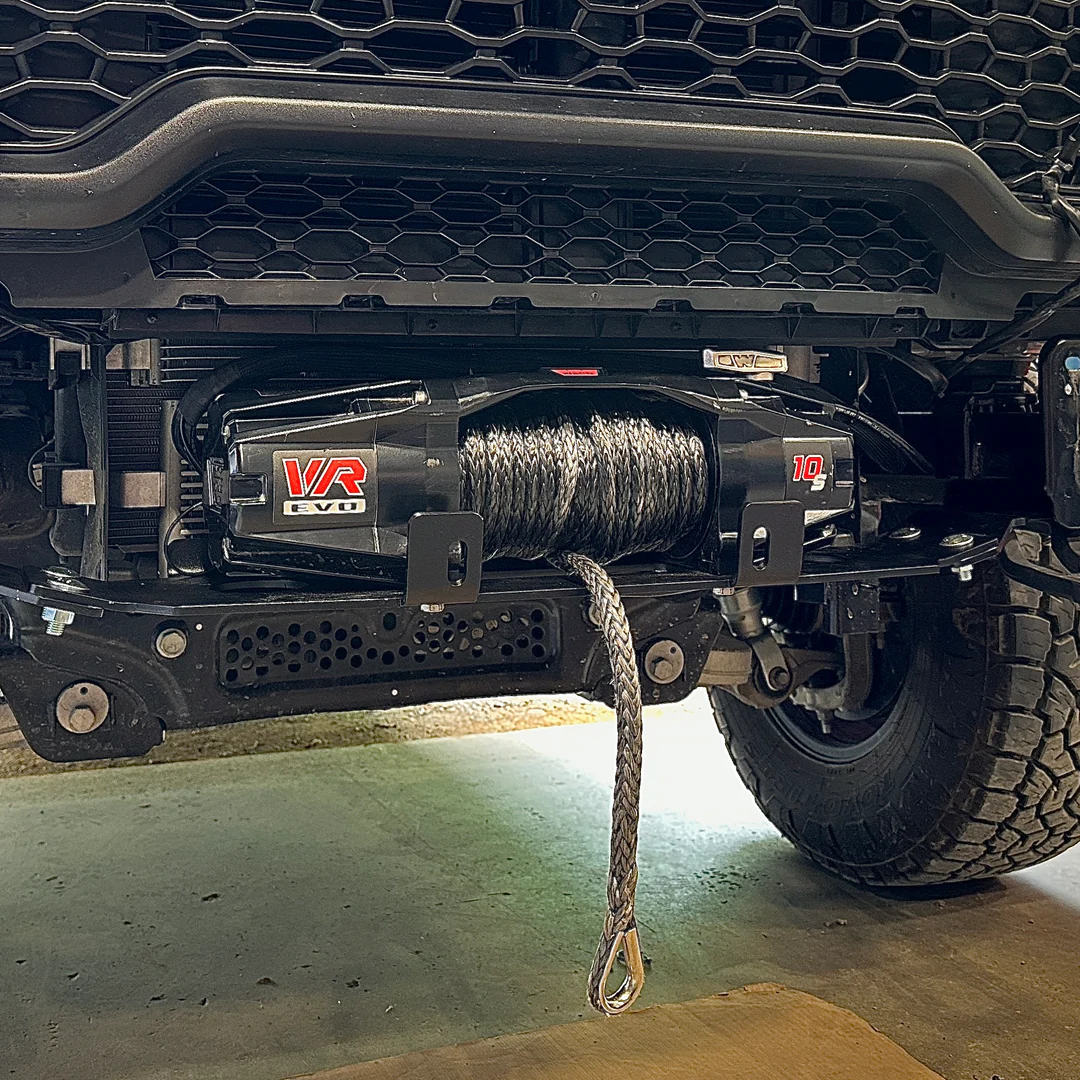 A truck winch is a powered pulling tool that bolts to your truck’s frame or a frame-tied bumper. It uses a drum wrapped with steel cable or synthetic rope and a gear-reduced motor to drag your truck, or someone else’s, out of mud, snow, sand, or over obstacles by spooling the line in under power. Most modern truck winches run off your truck’s 12V battery. Inside, you’ve got an electric motor, a reduction gearbox, and a brake system that holds the load when you stop pulling. You control it with a wired or wireless remote. For serious off-roading, overlanding, ranch work, plow trucks, or rescue rigs, a winch stops being an accessory and starts being a survival tool.
What Size Winch Does Your Truck Need? (GVWR × 1.5 Calculator)
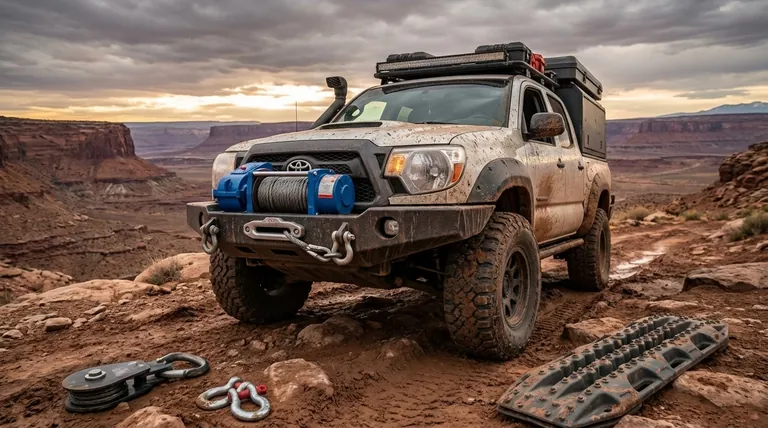 Winch sizing always starts with your GVWR (Gross Vehicle Weight Rating), not a sales brochure curb weight. Take that GVWR and multiply by 1.5. That gives you a baseline winch capacity, then you adjust for how you use the truck, how loaded it usually is, and whether you plan on single-line or double-line pulls. Out on the trail, you’re not pulling a dry, empty truck on flat pavement. You’re dragging a fully loaded rig buried to the frame in mud or stuck on a hill with a bad angle. That extra resistance is why GVWR is the number you respect and why the 1.5× factor has become the standard in serious recovery circles.
Step 1: Find Your Truck’s GVWR
GVWR is the maximum allowed weight of your truck with people, gear, fuel, and tongue weight. You don’t have to guess. You can find it in a few places:- The driver’s door jamb sticker on common platforms like Ford F-150, Toyota Tacoma, Ford Bronco, Chevrolet Silverado, RAM 1500 and so on.
- The specifications section in your owner’s manual if the sticker is missing or painted over.
- The manufacturer’s website or dealer system using your VIN if you want to double-check.
- Ford F-150: roughly 6,100–7,850 lbs, depending on cab, bed, and axle package.
- Toyota Tacoma: around 5,600–6,500 lbs.
- Ford Bronco: about 6,000–6,500 lbs with common trims.
- Chevrolet Silverado 1500: around 6,800–7,200 lbs, again depending on configuration.
Step 2: Apply the 1.5× Safety Factor
Once you have your GVWR, punch in this simple formula: Required Winch Capacity = GVWR × 1.5 Real-world examples using that rule:- Ford F-150 with 7,000 lbs GVWR → 7,000 × 1.5 = 10,500 lb minimum. In practice you round up to an 11,000–12,000 lb winch.
- Toyota Tacoma with 6,000 lbs GVWR → 6,000 × 1.5 = 9,000 lb minimum. Most folks end up in the 9,000–10,000 lb range.
- Ford Bronco at 6,200 lbs GVWR → 6,200 × 1.5 ≈ 9,300 lb. A 10,000–12,000 lb unit gives you breathing room for mods and cargo.
- Chevrolet Silverado 1500 at 7,100 lbs GVWR → 7,100 × 1.5 ≈ 10,650 lb. Realistically you pick an 11,500–12,000 lb winch.
Step 3: Single-Line vs Double-Line Pull
Every winch rating you see on the box, like 12,000 lbs, is measured as a single-line pull on the first wrap of rope or cable on the drum. As the drum fills with more layers, leverage works against you and the effective pull drops. A double-line pull using a snatch block changes things:- It can almost double your effective pulling power because you’re sharing the load through a pulley, though you lose a bit to friction.
- Your line speed is cut roughly in half, which is fine for hard recoveries where control matters more than speed.
- The load on your anchor and hardware changes. Every shackle, snatch block, and recovery point has to be rated high enough for that increased force.
- If you mainly handle light recovery on mild trails or forest roads, that 1.5× GVWR single-line winch is more than enough most days.
- If you expect nasty, sticky recoveries in gumbo mud, deep snow, or steep climbs, stick to at least 1.5× and plan on double-line pulls for the worst of it.
- Always have a properly rated snatch block, shackles, tree saver strap, and other recovery gear in the kit. The winch alone is only half the system.
Quick Capacity By Common Trucks
This table gives a quick starting point. Always confirm your exact GVWR and gear load, but these ranges work well for most builds.| Truck Model | Typical GVWR (lbs) | Recommended Winch Capacity (lbs) | Notes |
|---|---|---|---|
| Ford F-150 | 6,100–7,850 | 10,000–12,000 | Most half-tons are happiest with 10–12K winches, especially after armor and gear. |
| Toyota Tacoma | 5,600–6,500 | 9,000–10,000 | 8K will work for a light truck, but 9–10K is smarter for loaded overland Tacomas. |
| Ford Bronco | ~6,200 | 10,000–12,000 | Accessory weight adds up fast, so a 12K unit is often the long-term choice. |
| Chevrolet Silverado 1500 | 6,800–7,200 | 11,500–12,000 | Full-size body, bed cargo, and armor make a 12K winch a very safe bet. |
How to Choose the Right Winch for Your Truck
Capacity: More Than Just a Number
Capacity is your first filter. Start with the truck winch capacity guide of GVWR × 1.5, then fine-tune around your platform and build:- Mid-size trucks (Tacoma, Ranger, Colorado): 9,000–10,000 lb winches are the sweet spot for strength without killing the front suspension.
- Half-tons (F-150, Silverado 1500, RAM 1500, Bronco): Most owners live in the 10,000–12,000 lb range.
- Heavy half-tons or fully loaded rigs with campers, armor, and gear: 12,000–12,500+ lb winches give you insurance when things go sideways.
- Line speed: Faster line speed saves time when you’re resetting or doing repeated pulls. Just remember the quicker units can pull more amps, so your battery and alternator need to keep up.
- Drum size and rope length: A deeper drum with more line gives you flexibility on anchor points. Just remember pulling power is rated on the first wrap, so a totally full drum gives less grunt.
- Weight on your front axle: A steel bumper, big winch, and steel cable can add 150–250 lbs out front. On some half-tons, that’s the difference between riding level and sagging into your bump stops.
Motor Type: Series Wound vs Permanent Magnet
The motor is where a lot of cheaper winches cut corners. That’s where many folks get burned. You’ll mostly see two types.- Series wound motors
- Built for heavy, sustained pulls, like dragging a buried Silverado out of a ravine.
- Handle heat better, which matters when you’re winching longer than 20–30 seconds at a time.
- They do draw plenty of current but keep torque strong across the pull.
- My go-to for full-size trucks like F-150, Silverado, Bronco, and RAM 1500 that see real use.
- Permanent magnet motors (PM)
- Common on more budget-friendly and lighter-duty winches.
- Good efficiency at lower loads and usually a bit more compact.
- More sensitive to heat and voltage drops. Abuse them and they let you know.
- Perfectly acceptable for occasional pulls on mid-size trucks, lighter builds, or as an emergency backup.
- Warn VR Evo 12: 12,000 lb capacity with a series wound motor. This is the kind of winch I put on rigs that actually get used hard and often.
- Smittybilt X20-12000: 12,000 lb with a permanent magnet motor. Solid performance for the price, just treat the duty cycle with respect and watch the heat.
IP Rating: Weather and Water Resistance
A lot of people bolt a winch on and forget it lives up front in every storm and salt bath. The IP rating tells you how well it’s sealed against dust and water, which matters a lot for trucks that see rain, snow, mud, and creek crossings.- IP67 – Totally dust-tight and rated to survive temporary immersion up to about 1 meter. Good starting point for most users.
- IP68 – Also dust-tight with better protection against longer or deeper immersion. Usually means better seals and attention to gaskets and vents.
- Corroded gears and bearings in the gearbox that seize just when you need them.
- Water ingress in the control pack that leads to electrical gremlins and shorts.
- Fine grit and silt getting dragged into seals and chewing things up quietly over time.
Rope vs Cable: Which Is Better for Your Truck?
The synthetic rope vs steel cable debate fires up every trailhead parking lot. Both work. Which one is “better” depends on what you do with the truck and how honest you are about maintenance. Synthetic rope advantages:- Substantially lighter, which takes strain off your front suspension and makes handling the line way easier.
- Much safer if it snaps. It has less stored energy, so it tends to drop instead of whipping like a steel cable.
- Easy to handle with bare hands, to splice if damaged, and to reroute in tight spots.
- Floats in water, which is nice if you’re pulling across a stream or through deep mud where visibility is poor.
- More vulnerable to sharp edges, abrasion, and heat on the drum.
- Needs a smooth, aluminum hawse fairlead. Beat-up roller fairleads with burrs will eat synthetic line fast.
- Needs a little care. Mud, sand, and UV slowly break it down if you never clean or cover it.
- Tough in abrasive, rocky environments where the line drags over ledges and stumps.
- Handles drum heat better when you’re working near the winch’s upper limits.
- Usually cheaper up front and often comes stock on budget winches.
- Heavier, which stacks more weight way out front.
- Stores a lot more energy when under tension and can turn into a serious hazard if it lets go.
- Develops burrs and kinks as it ages, which can slice unprotected hands and weaken the cable.
Truck Winch Mounting: Bumper-Mount, Hitch-Mount & Hidden Mount
Your truck winch mounting options change how safe the system is, how well the truck works off-road, and how miserable or easy the install will be. You’re typically choosing between a factory bumper setup with a winch tray, a dedicated aftermarket bumper, a receiver hitch plate, or a hidden mount that tucks the winch out of sight.Factory Bumper Mount
On some trucks, you can tuck a winch behind or integrated with the factory bumper using a frame-tied winch tray. On others, the stock bumper is just a thin shell with no structure, and you’ll need more support. Things think through first:- Factory bumper vs aftermarket: Most OEM bumpers are designed for aerodynamics and minor bumps, not full winch loads. They usually need an internal winch tray tied directly to the frame.
- Bumper bolt pattern diagram: Each platform has its own bolt spacing and hole sizes where the bumper meets the frame horns. Any winch mount or tray must match that pattern to be safe.
- Factory bumper drilling: On some trucks you can keep the stock bumper by trimming plastic or cutting a slot for the fairlead while bolting a proper winch tray behind it.
- The truck keeps a mostly stock appearance, which some owners and HOAs like.
- You usually keep a better approach angle than a low, hanging hitch setup.
- If a bolt-on winch tray exists for your exact truck, it can be cheaper than a full steel bumper.
- Space gets tight. Larger 12K winches and tall control packs may not clear factory plastics or grilles.
- Airflow to the radiator and intercooler can suffer if the winch sits right in front of them. That matters on trucks that tow or climb long grades.
- Accessing the drum to respool rope, inspect connections, or service the winch can be annoying if everything is buried behind plastic.
Aftermarket Bumper (Rough Country, Westin & Others)
Most owners who are serious about recovery end up with an aftermarket bumper that has a built-in winch mount. Brands like Rough Country and Westin offer bolt-on bumpers for Ford F-150, Toyota Tacoma, Ford Bronco, and Chevrolet Silverado that are designed from day one to carry a winch. What I look for in a good bumper:- An integrated winch plate that’s clearly rated above your winch capacity and ties directly into the frame rails.
- A published mounting bolt pattern matching the standard 10” × 4.5” winch footprint, and mounting hardware that lines up with your frame horns without sketchy adapters.
- Proper openings for the fairlead and a design that tucks the winch high so you don’t lose half your approach angle.
- Real recovery points, like welded D-ring mounts that run through the bumper skin into the frame, not just decorative tabs.
- By far the strongest and most secure way to mount a winch for repeated hard pulls.
- Often improves your approach angle compared to stock, because the bumper is cut for clearance and the winch is pulled in tight.
- You also gain better protection, extra light mounts, and integrated recovery points in one package.
- You’re buying a bumper, possibly lights, probably paint or coating, and maybe suspension parts. It adds up.
- The bumper and winch combo is heavier. Many trucks need stiffer springs or leveling kits to sit right again.
- Install can take a weekend if you’re doing it yourself. Trimming plastic, relocating sensors, and aligning body lines all take time.
Hitch Plate Mount (Front or Rear Receiver)
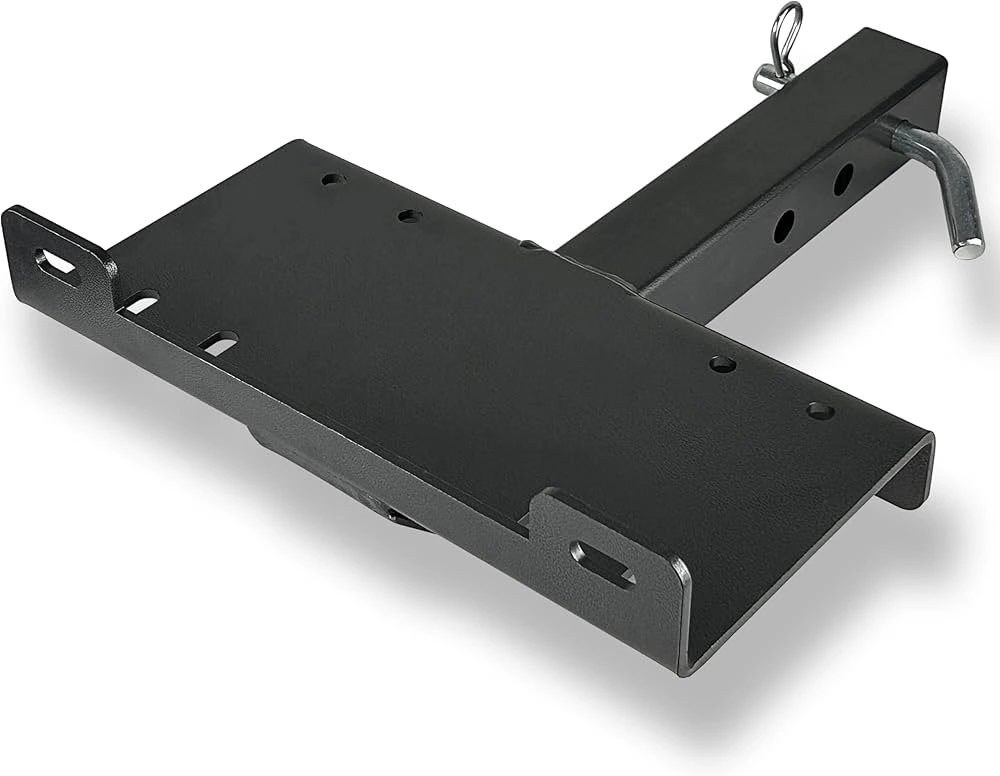 A receiver hitch mount uses a 2-inch receiver hitch and a winch plate that slides in like a ball mount. You can do this on the front with a front mount receiver or on the rear with the factory tow hitch. Some bumpers even include a bumper receiver for this setup. Key safety checks:
- Verify the receiver and hitch are rated for recovery-type pulling loads, not just static towing capacity.
- Make sure the plate itself is made from thick enough material and has proper gussets for the winch you’re running.
- Understand that a front receiver and plate often hang below the bumper and can easily become a rock magnet.
- You can move the winch between the front and rear of the same truck, or between multiple trucks that share the same receiver size.
- You can pull the winch off and store it indoors between trips, which helps with theft prevention and extends its life.
- The hardware cost is usually lower than a full steel bumper with winch mount.
- A low hitch plate can absolutely brutalize your approach angle. It’s usually the first thing to scrape on rocks or ruts.
- The receiver now sees recovery loads that can be much higher than regular towing loads. Respect its rating.
- Wiring becomes more complex, because you need heavy quick-disconnects and longer cable runs, which increase voltage drop.
How to Wire a Winch on a Truck
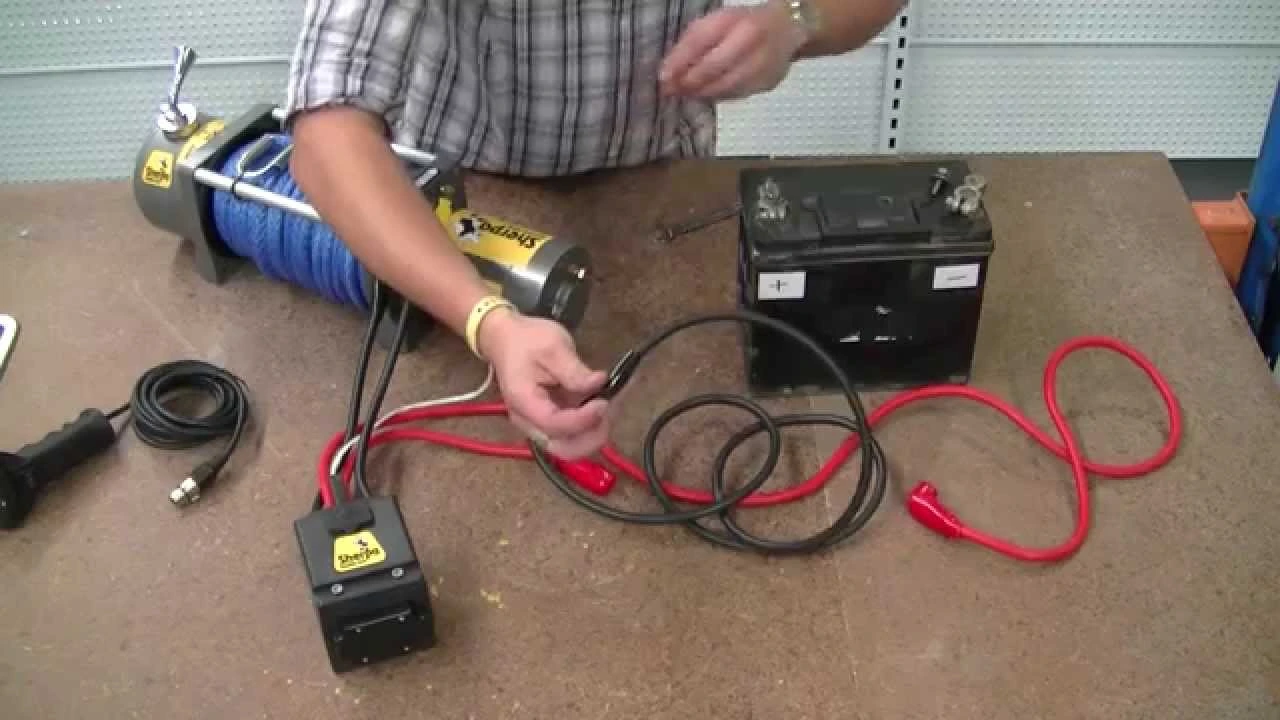 Wiring a truck winch right is as important as choosing a good winch. You’re dealing with high current, so sloppy work can mean slow performance at best and fires at worst. The core process is simple: run heavy cables from the battery to the solenoid/control box, place a proper fuse or breaker near the battery, and make sure your ground is as solid as your positive feed. If you need full diagrams and amp calculations tailored to your truck, you’ll want to reference the truck winch capacity calculator and truck winch amp draw specs side by side.
Cable Routing from Battery
Good winch cable routing is all about getting power where it needs to go with minimal loss and no rubbing or melting along the way. From the EAV data for routing, a few things matter every time:- Gauge (AWG): Most 10–12K winches use 2 AWG or 1/0 AWG depending on how long the run is.
- Battery distance (feet): The shorter the run, the less voltage drop. Front-mounted winches usually see 4–8 feet of cable between battery and control pack.
- Firewall grommet size (diameter): When you run signal or switch wires into the cab, a 3/4″–1″ grommet is common. High-current cables stay out in the engine bay.
- Run both the positive and negative cables straight from the battery area to the winch solenoid/control pack as directly as is safe.
- Shadow the factory harness paths along inner fenders and frame rails whenever possible. The engineers already picked safe routes.
- Use cable loom routing like split loom or braided sleeve on all exposed runs to protect against chafing and road debris.
- Secure the cables with insulated clamps or good quality zip ties every 12–18 inches so the weight of the cable never hangs on a lug.
- Keep clear of sharp body seams, hot exhaust, and moving parts like steering linkages, fans, and pulleys.
Fuse Placement and Rating
A lot of older installs skipped fuses on winches. I’ve seen the aftermath. To protect the truck, every modern install should use a properly sized fuse or circuit breaker on the positive cable near the battery.- Fuse holder location: Mount it within 18 inches of the positive battery terminal. That way nearly the entire run is protected.
- Fuse rating (amps): Match it to the winch’s max current draw and your cable size. Most 10–12K winches end up in the 300–500 amp range.
- Choose a marine-grade fuse holder or breaker. They’re built to deal with heat, moisture, and vibration.
- Mount it rigidly to a metal bracket, battery tray, or inner fender, not hanging from the wire by hope and zip ties.
- Protect the short length of cable between the battery post and the fuse with loom and maybe edge guards if it passes near anything sharp.
Ground Cable and Battery Connections
The ground cable is often where people cheap out, then complain their winch is slow or weak. Current has to get back to the battery just as easily as it left it.- Use the same AWG gauge for the ground as you use for the positive. Mixing sizes is just asking for a bottleneck.
- Ground the winch directly to the battery negative or to a solid, factory-approved grounding stud that ties to the battery with a heavy strap.
- Grind or sand off paint and rust where the lug meets bare metal, then coat after assembly to keep corrosion at bay.
- Use quality tinned copper lugs that actually match the wire and stud sizes instead of forcing mismatched parts.
- Crimp them with a real hex or hydraulic crimper. Hammer crimp tools are a last resort and often give inconsistent results.
- Seal the joint with adhesive-lined heat-shrink so moisture and salt can’t creep in.
- After a couple of good winching sessions, recheck and re-torque the battery and ground connections. Things settle.
Truck-Specific Fitment Guide
Every truck platform has its own little fitment tricks. Frame horns, bumper brackets, sensor locations, and intercooler placements all change how a winch sits. Below are practical notes for Ford F-150, Toyota Tacoma, Ford Bronco, and Chevrolet Silverado. Always verify details for your exact model year and trim before ordering parts.Ford F-150
The Ford F-150 is a common canvas in the shop, and the aftermarket support is deep. That makes life easier if you pick the right combination of parts. Key attributes (EAV-based):- GVWR: Typically 6,100–7,850 lbs depending on engine, cab, and axle package.
- Bumper bolt pattern: Hole spacing and diameters vary by generation, but most quality aftermarket winch bumpers are built around the stock frame horn pattern.
- Receiver hitch rating: Often 5,000–12,000 lbs for towing. Recovery loads can be different, so check the fine print and the frame reinforcement.
- Recommended winch capacity: 10,000–12,000 lbs for anything other than the lightest builds.
- You’ll find plenty of Rough Country bumper and Westin bumper options with integrated winch plates for F-150s in different generations.
- Certain years can run a hidden mount winch tray behind the OEM bumper by trimming lower valances and grille plastics.
- Always check the winch footprint against the bumper’s bumper bolt pattern diagram and rated capacity. Don’t assume any 12K winch fits every bumper slot.
Toyota Tacoma
The Toyota Tacoma can be lighter than a full-size, but most Tacomas I see are loaded with armor, camping gear, and big tires. That extra mass makes a winch almost mandatory if you leave pavement regularly. Key attributes:- GVWR: Around 5,600–6,500 lbs depending on cab, bed, and trim.
- Factory bumper strength: Thin and mostly cosmetic. You’ll need a reinforcement plate or winch tray, not just the bumper skin.
- Aftermarket bumper options: There are dozens of winch-ready bumpers across many brands for the Tacoma.
- Mounting compatibility: Usually excellent with bolt-on winch plates or bumpers, as long as you match the parts to your model year.
- Hidden winch trays behind the stock bumper are common, but usually involve cutting the crash bar, trimming plastic, and sometimes relocating coolers.
- A good steel bumper with an integrated winch plate is the most solid setup if you travel loaded and far from help.
- A 9,000–10,000 lb winch with synthetic rope keeps the front weight down and still gives plenty of pull on a built Tacoma.
Ford Bronco
The modern Ford Bronco rolled out with off-road use in mind, so Ford and the aftermarket have given it decent winch options from day one. Notes:- Several trims support a modular bumper that’s already punched and braced for winch mounts.
- Hidden winch trays sit between the frame rails and often need factory bumper drilling or plastic trimming for a clean fairlead opening.
- Approach angle is a big selling point on the Bronco. Most owners choose high-clearance bumpers that keep the winch high and tight.
Chevrolet Silverado 1500
The Chevrolet Silverado 1500 has a strong frame, but the factory front end isn’t as winch-friendly as some rivals. That’s why you see so many Silverados running aftermarket bumpers or custom trays. Fitment considerations:- Check the frame horn bolt pattern and bumper bracket style for your exact year, especially if you’re mixing brands of bumper and winch tray.
- Some winch kits tuck behind or slightly modify the factory bumper, while others replace it entirely.
- Between a steel bumper and winch, you can add serious weight to the nose. Most owners end up upgrading front springs or leveling the truck afterward.
How to Wire a Winch on a Truck: Step-by-Step
This step-by-step walks through wiring a front bumper-mounted winch wired directly to the battery. The hardware and exact routing will vary by truck, but the sequence and logic stay the same. Always keep the winch manufacturer’s instructions in front of you while you work.Step 1: Plan Mounting and Cable Paths
- Verify that your mounting plate selection or bumper is rated for the winch’s capacity and ties into the frame, not just the bumper skin.
- Look under the hood and trace a safe path from the battery to the winch that avoids sharp edges, heat sources, and moving parts.
- Choose where you’ll mount the fuse holder and where the remote control plug or in-cab switch will live so they are accessible but protected.
Step 2: Mount the Winch
- Set the winch into the bumper or tray and bolt it down using the proper bolt pattern and grade 8 (or equivalent) hardware that came with the mount or winch.
- Torque the mounting bolts to spec and use thread locker if the instructions call for it to keep things tight over rough roads.
- Install the hawse or roller fairlead square and flush with the bumper opening so the line feeds smoothly and doesn’t rub on edges.
Step 3: Install the Control Pack/Solenoid
- Mount the control pack as directed in the winch instructions, whether that’s on top of the winch, above the bumper, or on a nearby bracket in a hidden mount.
- Keep it clear of direct exhaust heat, and try to avoid locations where water and mud will constantly blast it.
- Hook up the short motor leads to the control pack, matching each wire to its labeled terminal so the winch runs in the proper direction.
Step 4: Route Power and Ground Cables
- Measure and cut new cables if your winch didn’t come with the right lengths. Do a dry run first so you don’t cut them short.
- Select the proper AWG gauge for your winch size and run length. Most 10–12K truck winches want 2 AWG or 1/0 AWG.
- Route the cables along frame rails or alongside existing harnesses, then cover them with cable loom routing to protect the insulation.
- Secure the cables every 12–18 inches with clamps or heavy zip ties so vibration can’t work the lugs loose.
Step 5: Install Fuse or Circuit Breaker
- Mount a high-amp fuse or breaker on the positive cable within 18 inches of the battery’s positive post.
- Size the fuse rating (amps) to the winch’s maximum draw and the capacity of the cable, giving you protection without nuisance trips.
- Cover exposed studs or terminals with boots or high-quality tape so nothing metallic can bridge them accidentally.
Step 6: Make Battery Connections
- Disconnect the negative battery terminal first, then the positive, before you make any connections to avoid accidental shorts.
- Connect the winch’s positive cable from the control pack to one side of the fuse, then from the fuse to the battery positive terminal.
- Connect the winch’s ground cable directly to the battery negative or to a known good ground point that ties back to the battery with a heavy strap.
- Use properly crimped and heat-shrunk lugs, then tighten all connections to the torque values recommended by the hardware manufacturer.
Step 7: Route Control/Remote Wiring
- Run the small control harness to a convenient remote socket location in the grille area or on the bumper, or to an in-cab switch panel.
- If you’re going into the cabin, go through an existing through-firewall grommet or install a new grommet in a drilled hole. Keep the wires away from sharp metal edges.
- Seal any new holes you make and secure the harness so it doesn’t rub or dangle near pedals, steering shafts, or hot HVAC components.
Step 8: Test the System
- Reconnect the battery, positive first, then negative, and check for any signs of shorting or heat while standing by with an extinguisher just in case.
- Plug in the remote and test the winch “in” and “out” with no load. Make sure the drum turns in the right direction compared to the switch labels.
- Turn the steering wheel lock-to-lock and cycle the suspension if you can, watching that no cable gets tight, rubs, or contacts moving parts.
Common Truck Winch Mistakes (and How to Fix Them)
I see the same problems over and over again in the shop and out on the trail. Most are preventable, and most get blamed on the winch when the real issue is the setup. Here are some of the repeat offenders and how to fix them before they ruin a trip.- Mistake 1: Undersizing the winch.
- Issue: Someone hangs an 8,000 lb winch on a 7,000 lb GVWR F-150 because it was on sale and “ought to be enough.”
- Fix: Respect the GVWR × 1.5 rule and move to a 10–12K winch. You’ll thank yourself when the truck is buried to the frame.
- Mistake 2: Mounting to a weak or unsupported bumper.
- Issue: Bolting the winch through thin factory bumper skin or a light-duty bull bar that only ties into bumper brackets.
- Fix: Use a frame-tied mount or aftermarket bumper that’s rated to handle winch loads without bending or tearing off.
- Mistake 3: Running cables near hot exhaust or moving parts.
- Issue: Cable insulation softens from exhaust heat, or a steering shaft slowly saws through a power cable, leading to shorts and fires.
- Fix: Reroute cables and protect them with cable loom, heat shields, and proper clamps away from anything hot or moving.
- Mistake 4: Skipping a fuse or breaker.
- Issue: A chafed cable or crushed connector causes a dead short, and with no fuse the battery dumps everything it has into the arc.
- Fix: Install a correctly rated fuse within 18 inches of the positive battery terminal on the winch feed line every time.
- Mistake 5: Ignoring duty cycle.
- Issue: Non-stop, full-load winching cooks the motor and solenoid pack, often within a single ugly recovery.
- Fix: Watch your duty cycle, winch in shorter bursts, and let the system cool between heavy pulls.
- Mistake 6: Poor rope/cable maintenance.
- Issue: Frayed synthetic rope or kinked steel cable is left in service and fails without warning under load.
- Fix: Inspect the line before every big trip, respool it evenly under tension, and retire anything with serious damage.
- Mistake 7: Overlooking approach angle impact.
- Issue: A hitch-mounted winch plate constantly drags on ruts and rocks, negating the truck’s front clearance.
- Fix: Go with a high-mounted bumper winch or a well-designed hidden mount that preserves approach angle and tucks the winch up higher.
Truck Winch FAQ
These are the questions I hear from truck owners in the shop, on the phone, and out on the trail. The answers below should clear up most of the confusion before you start buying parts.How do I size a winch for my truck?
Use your truck’s GVWR (Gross Vehicle Weight Rating) multiplied by 1.5 as your minimum capacity. So if your truck is 7,000 lbs GVWR, you’re looking for at least a 10,500 lb rating. In the real world that means you buy an 11,000–12,000 lb winch. If you run heavy gear or see a lot of mud and hills, going one size larger is cheap peace of mind.Is a series wound motor better than a permanent magnet motor?
For full-size trucks and anyone who winches more than once every few years, a series wound motor is usually the right call. It deals with heat better and keeps pulling hard under sustained load. A permanent magnet motor is fine for occasional use, lighter mid-size trucks, and budget builds as long as you respect its duty cycle and don’t try to treat it like a commercial recovery winch.Should I choose synthetic rope or steel cable?
Synthetic rope is what I recommend for most modern truck owners. It’s lighter, easier to handle, and far more forgiving if something fails. Steel cable still makes sense for harsh, abrasive environments like logging, rock quarries, or heavy industrial work where the line is constantly dragging over nasty surfaces. Either way, match the line size to the winch rating, protect it from sharp edges, and replace it at the first sign of serious damage.What are the main truck winch mounting options?
You’ve got three big choices. A bumper-mount, either factory with a winch tray or full aftermarket bumper, which is the most secure. Hitch plate mounts that slide into a receiver if you want to move the winch between vehicles or front and rear. And hidden mounts that live behind the stock bumper if you want a stealthy look while still having a winch on board. Bumper mounts win for strength, hitch mounts for flexibility, and hidden mounts for looks.How hard is it to wire a winch to a truck battery?
If you’re comfortable with basic 12V wiring and can follow a diagram, it’s very doable. You’ll run heavy cables from the battery to the solenoid and winch, install a large fuse or breaker within 18 inches of the positive battery terminal, and make a solid ground connection. Protect everything with loom and grommets where it passes through metal, and double-check all crimps and lugs before you power it up.What’s the best winch for a Ford F-150?
For a Ford F-150, a 10,000–12,000 lb winch is the right range for almost every build. The Warn VR Evo 12 is a strong choice if you want a series wound motor and long-term reliability. The Smittybilt X20-12000 is a solid budget option that still hits 12K capacity. Pair either one with a quality bumper from Rough Country or Westin and you’ll have a system you can trust.Can I mount a winch to my factory bumper?
Some trucks can run a winch tray tucked behind the factory bumper, but the bumper skin itself usually isn’t up to the task. If there’s no frame-tied tray available for your truck, you’re better off with a frame-tied winch tray kit or an aftermarket bumper that includes a rated winch plate. Avoid bolting straight through thin metal or plastic bumper covers.Do I need to upgrade my battery or alternator for a winch?
A healthy stock battery and alternator can handle occasional winch use if you keep pulls short and the engine running. If you plan on frequent, long pulls or you run a lot of other electrical gear, a higher-capacity battery, dual-battery setup, or upgraded alternator is smart. Use your winch’s amp draw specs and a good truck battery sizing for winch guide to see how hard the winch will hit your charging system.Which brands make the most reliable truck winches?
Warn, Smittybilt, and Superwinch are all proven names in the truck world. Warn sits at the premium end with very durable series wound units and strong support. Smittybilt and Superwinch give you a lot of performance for the dollar and work well for most enthusiasts. Regardless of brand, compare capacity, motor type, IP rating, duty cycle, and warranty before you swipe the card.Is this guide for Jeep or trailer winches too?
This guide is written around truck-specific winch selection, mounting, and wiring. A lot of ideas carry over to Jeeps and trailers, but those applications have their own quirks. For trailer winches, head to /winch/trailer/. For Jeep-specific winch setups, check the Jeep winch hub at /winch/jeep/. If you’re after hand winch info, that’s covered at /winch/hand/.Final Summary & Next Steps
Adding a truck winch is one of the smartest upgrades you can make if you leave pavement or work in remote spots. Start by doing the math with your GVWR × 1.5 capacity and then choose a winch with the right motor type, IP rating, and rope or cable for how you really use the truck. Bolt it to a frame-tied bumper or plate that doesn’t wreck your approach angle and is actually rated for the forces involved. Wire the winch correctly from battery to bumper with the proper gauge cables, a high-amp fuse within that 18-inch window from the positive terminal, solid grounds, and protected routing with loom, clamps, and firewall grommets. Once it’s in, keep the connections tight, inspect the rope or cable regularly, and practice using the winch in a controlled setting before you need it in a storm, at night, or hanging off a ledge. Ready to dial in your setup?- Run the truck winch capacity calculator with your exact GVWR, accessories, and battery setup.
- Compare options in the motor type comparison to pick between series wound and permanent magnet for your usage.
- Follow the detailed steps in the truck winch installation full guide when you’re ready to mount and wire your system.
🔧 Bench-Tested Truck Winches Head-To-Head
I ran four truck-class winches through full bench testing: Warn Zeon 12 Platinum, Warn VR EVO 12-S, Smittybilt X2O 12, Badland Apex 12k. Each pulled full rated load until thermal cutoff, measured with a Dillon AP 20,000 lb load cell and Fluke 62 MAX+ IR thermometer. Warn Zeon ran 4 min 12 sec before trip. VR EVO: 2 min 50 sec. Smittybilt: 1 min 35 sec. Badland: 52 sec. For the daily-driver truck that occasionally pulls a stuck rig, any of the first three work. Skip the Badland for serious use.