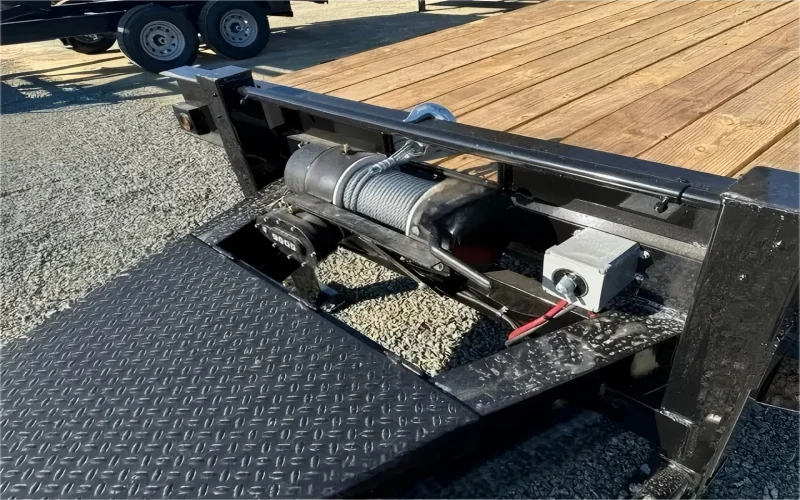
Trailer winches are different from truck winches. Designed for loading vehicles onto trailers, not self-recovery. Lower capacity, often manual/hand-crank for boats.
Mounting matters. Most trailer tongues need 1/4″ steel reinforcement plate — stamped sheet metal bends under winch load.
12V tap: use a dedicated tongue-mounted battery or a 7-way plug with 12-gauge dedicated power wire. Trailer wiring can’t handle 200A+ winch loads.
TL;DR: A trailer winch turns loading cars, boats, and equipment from a sketchy wrestling match into a controlled pull. Pick your type (hand, 12V electric, or drill-powered hybrid) based on what you’re loading, how often you do it, and your budget. Then size the winch with a healthy safety margin, bolt it to a reinforced part of the trailer (usually the tongue or A-frame), and feed it with properly fused 12V power using the right gauge cable.
Key Takeaways
Hand ratchet winches are cheap, simple, and great for light loads and backup duty. 12V electric trailer winches are the workhorses for frequent or heavy loading. Drill-powered “hybrid” winches sit between the two and suit the occasional user.
For a car trailer winch, a good starting point is about 1.5× the vehicle weight on level ground. Then bump the capacity up as the ramps get steeper, the driveway gets slicker, or the rollers get tighter.
Use rolling resistance and incline grade (for example an 11% driveway slope) to estimate how much the winch actually has to pull, then layer on a safety factor so you’re not running the winch at its limit every time.
Common mounting spots are the A-frame tongue, a tongue-top plate, and heavy side rails. No matter what you pick, use through-bolts with backing plates and reinforce the tongue so it does not twist or buckle.
12V trailer power can be supplied from the tow vehicle or a dedicated battery box on the trailer. Use the correct AWG cable, solid grounds, and an inline fuse or breaker mounted close to the power source.
On a boat trailer winch setup, corrosion resistance, proper strap and roller alignment, and a rock-solid winch post mount matter just as much as capacity.
Brands like Dutton-Lainson, Fulton, and Warn have earned their reputations for reliable trailer winches across both hand and electric options.
Never stand in the line of pull of a winch strap or cable. Inspect the winch mount, bolts, wiring, and winch strap guide roller regularly before they remind you the hard way.
What Is a Trailer Winch?
Tongue-mount is the standard. Reinforce; don’t trust stock sheet metal. A trailer winch is a pulling device you mount on a trailer to drag cars, boats, or equipment up ramps or onto a deck. It uses a strap, rope, or steel cable wrapped on a drum and converts either your muscle, 12V battery power, or the torque of a cordless drill into steady pulling force. Common types include:
Car trailer winch – set up on car haulers and flatbed trailers to pull non-running or hard-to-load cars, SUVs, and trucks safely up the ramps.
Boat trailer winch – mounted on a winch post to pull the boat up the trailer bunks or rollers and snug it to the bow stop.
Flatbed winch – used on equipment and deck-over trailers for ATVs, side-by-sides, tractors, or machinery.
Hand trailer winch – a manual ratchet or brake winch that you crank by hand, used for lighter loads or occasional pulls.
12V electric trailer winch – driven by a 12-volt system from the tow vehicle or a trailer-mounted battery box for heavier loads and frequent use.
Types of Trailer Winches (Hand Ratchet, Electric 12V, Drill-Powered)
Trailer winches generally fall into three camps: hand ratchet, 12V electric, and drill-powered hybrid. They all do the same basic job, but the cost, speed, power source, and how tired you are after loading will be very different. Hand ratchet winches are simple and tough. No wiring to worry about, just your arms and a bit of patience. Electric 12V trailer winches add speed, a lot of convenience, and the ability to load heavy vehicles solo, but they need proper electrical work. Drill-powered winches sit in between, giving you powered assist when you still want something compact and low-tech.
Hand Ratchet Trailer Winch
A hand trailer winch uses a crank handle that turns a drum through gears, while a ratchet pawl locks the load from rolling back. You’ll see these all over boat ramps and on smaller utility and equipment trailers where loads are moderate and time isn’t critical. Pros:
No 12V wiring or battery required. You can bolt it on and go, which makes it perfect for simple trailers and older rigs without extra electrical capacity.
Lower cost. Well-known brands like Dutton-Lainson and Fulton winch models have proven gearsets and ratchets that hold up for years if you keep them clean and lightly lubed.
Simple upkeep. In practice, maintenance is just checking that the ratchet pawl is engaging fully, keeping the pivot and gears from rusting, and replacing the strap if it shows fraying, cuts, or sun damage.
Cons:
They’re slow, especially on long trailers or tall ramps. Hand-cranking a heavy boat or car for 15 or 20 feet gets old quick.
The heavier and steeper the pull, the more physical effort you’re putting in. On a big boat or heavy car, most people run out of steam before the job is done.
Not ideal for frequent heavy car hauler duty or daily commercial use. You can do it, but you’ll eventually wish you had an electric car trailer winch.
12V Electric Trailer Winch
A 12V electric trailer winch uses a DC motor, usually controlled by a solenoid and remote, to spin the drum. It ties into a 12V battery on the tow rig or a dedicated battery box on the trailer. For anyone who loads heavier vehicles more than a few times a year, this is usually the right call. Pros:
Much faster and far less effort, even on steep ramps or when the vehicle isn’t helping at all. Press the button and let the motor work while you steer or spot.
Handles heavier loads like full-size trucks, SUVs, and tractors that would be miserable or unsafe with a hand winch.
One-person operation is realistic. A remote lets you stand where you can see the whole setup instead of being stuck at the tongue.
Cons:
Needs proper 12V trailer power wiring. Wrong wire gauge, missing inline fuse, or poor grounds will give you weak pulls or hot, damaged cables.
Higher upfront cost and ongoing electrical maintenance. Connections corrode, solenoids wear, batteries age. You do have to stay on top of it.
Current draw is no joke. Big units can pull 200 amps or more. A standard 7-pin trailer plug circuit alone won’t handle that for a full pull.
Drill-Powered Hybrid Winches
Drill-powered or “hybrid” trailer winches look like standard manual winches but have a stub or hex on the input shaft you can spin with a cordless drill. That gives you power assist without hardwiring a full electric system. Pros:
You get powered help using a cordless drill, so there’s no need to run heavy power cables or mount a battery box if you’re trying to keep the trailer simple.
If the drill battery dies or the drill breaks, the hand crank still works, so you’re never stranded.
Perfect for medium loads and a car hauler winch that only sees occasional use, where a full 12V electric trailer winch feels like overkill.
Cons:
Your pulling power is limited by the drill’s torque and battery capacity. A small homeowner drill is going to struggle badly on heavy vehicles.
Even with a strong drill, they’re usually slower than a dedicated 12V electric winch and not as forgiving on long, hot pulls.
You have to keep the drill square to the shaft. If you run it crooked or let it wobble, you can round off the drive or hurt the winch gearbox.
Comparison Table: Hand vs Electric vs Drill-Powered
Here’s a quick side-by-side so you can match the type to how you actually use your trailer:
Type
Typical Cost
Speed
Power Source
Maintenance
Best For
Hand ratchet winch
Low
Slow
Human power
Low (lubricate, inspect strap/cable)
Small boats, light trailers, backup use, simple setups
12V electric trailer winch
Medium–High
Fast
12V battery on tow vehicle or trailer
Medium (electrics, battery, corrosion control)
Car trailer, flatbed winch, frequent heavy loads, solo loading
Drill-powered hybrid
Low–Medium
Medium
Cordless drill + manual backup
Low–Medium (gearbox, shaft, strap)
Occasional car hauler, medium boats, DIY users with good drills
For more detail on types and when to use a come-along for trailer recovery, visit:
What Size Winch for a Car Trailer? (Capacity Calculator by Vehicle Weight)
Match trailer winch to what gets loaded most often, not the trailer’s max. Picking the right car trailer winch capacity is where a lot of people go wrong. They look at vehicle weight, buy something close to that number, and only later realize the winch has to fight ramp angle, tire drag, and sometimes stuck brakes. A better starting point is about 1.5× the vehicle weight for level pulls, then adjust based on incline and conditions. If you want to crunch exact numbers, use our capacity calculator after you understand the basics below so you know what the numbers mean in real life.
Core Winch Capacity Formula
The basic winch capacity formula for sizing a car hauler winch looks at the forces trying to keep the vehicle from moving. You consider:
Vehicle weight (or GVWR if you are not sure of actual weight).
Rolling resistance coefficient for the tires and surface. This is how much the vehicle “fights back” as it rolls.
Incline grade, like an 11% grade driveway, which adds a chunk of the vehicle’s weight into the pull.
Safety factor, usually at least 1.5×, so the winch is not flat-out every time you touch the switch.
A simple way to look at it: Required Pull (lbs) ≈ Vehicle Weight × (Rolling Resistance + Incline Factor) × Safety Factor
Rolling resistance coefficient: For a vehicle on good, inflated tires on ramps, use 0.03–0.05 (3–5%). If you’re dragging a flat-tired rig or something with seized brakes, think in the 0.1 (10%) or higher range.
Incline grade: 0 on dead level, 0.11 for an 11% ramp, 0.15 or more for something pretty steep.
Safety factor: At least 1.5. On a commercial or hotshot trailer, many people go higher for long-term reliability.
Example: 4,000 lb sedan with good tires, rolling resistance of 5% (0.05), on an 11% (0.11) ramp, using a 1.5 safety factor.
Load factor = 0.05 + 0.11 = 0.16
Base pull = 4,000 × 0.16 = 640 lbs
Required winch rating ≈ 640 × 1.5 ≈ 960 lbs
On paper that looks small, but winches are rated on the first wrap and sold in standard sizes like 2,000, 3,500, 5,000 lbs and up. In the real world, you’d choose something in the 2,000–3,500 lb range at an absolute minimum, and most folks go even larger for speed, less strain, and room for ugly scenarios like flats or mud.
Car Hauler Winch Sizing by Vehicle Class
Here’s a practical set of car hauler winch size recommendations for typical vehicles on moderate ramps (around 11% or less), with good tires and working brakes. This is what actually works for most trailers I see, not just what barely passes on paper.
Vehicle Class
Vehicle Weight Range (lbs)
Recommended Winch Capacity (lbs)
Notes
Compact / Sedan
2,800–3,800
3,000–4,500
A solid 3,000 lb winch is fine on level ground. If you’ve got ramps, steeper driveways, or you load often, 4,000–4,500 lb units pull smoother and last longer.
Mid-size SUV / Crossover
3,800–5,000
4,500–6,000
These vehicles start to stress smaller winches. A winch with a bigger drum and sturdier gears handles repeated pulls without overheating or chewing itself up.
Full-size SUV / 1/2-ton truck
5,000–7,000
6,000–9,500
Err toward the higher side if you deal with steeper approaches, gravel, or wet surfaces where wheels don’t roll as easily.
3/4-ton & 1-ton truck
7,000–10,000+
9,500–12,000+
At this size, you’re into professional-grade electric winches and heavy-duty trailer construction. The tongue and frame need serious reinforcement.
Expert tip #1: If the vehicle is disabled with flat tires, frozen brakes, sunk into soft ground, or full of extra weight, treat rolling resistance as 10–20%. In those situations, snatch blocks, extra rigging, and a stronger winch aren’t just handy. They’re often the only way the load is moving.
Understanding Trailer GVWR and Tongue Capacity
The winch isn’t yanking on thin air. All that pulling force has to travel through the trailer tongue and frame. If the trailer is built light and you bolt a monster winch on it, something else can become the weak link.
Trailer GVWR (Gross Vehicle Weight Rating) is the maximum allowed loaded weight. This gives you a sense of how beefy the frame and axles are supposed to be.
Trailer tongue capacity is often 10–15% of GVWR on a balanced trailer. That tells you how much vertical load the coupler and tongue were designed to handle, which relates to how stout the front structure is.
A quick sanity check is the 1.5× GVWR rule. Your winch mount and tongue structure should be able to comfortably handle forces at least 1.5 times the trailer’s GVWR when the pull is fed through the frame. Pair that with a trailer tongue weight chart to make sure you’re not overstressing the coupler or bending the tongue, especially if the winch sits way forward or high. Expert tip #2: That winch capacity number on the box assumes the cable is on the first wrap of the drum. As the drum fills with more layers, the effective pulling power drops because the drum diameter grows. That’s another reason veteran haulers oversize their trailer winch a bit and avoid spooling all the line out unless they have to.
EAV Table: Car Hauler Winch Sizing
This table sums up the ranges you’re usually working in for a typical car trailer setup:
Attribute
Typical Value
Vehicle weight range (lbs)
2,800–10,000+
Trailer GVWR (lbs)
7,000–14,000+
Rolling resistance (% of weight)
3–5% (good tires), 10–20% (flat or stuck)
Incline factor (% of grade)
0–15% typical driveway/ramp
How to Mount a Trailer Winch: Front, Side & Modular Options
A strong trailer winch mounted the wrong way is almost as bad as no winch at all. The mount has to spread the pulling load through the trailer frame, not just yank on a thin plate. The winch also needs to sit in line with the pull so the strap or cable spools straight and does not saw into edges. Most folks end up with one of three positions: an A-frame mount at the tongue, a tongue-top mount plate, or a side rail mount. All of them can work great if you build them right. In every case:
Use through-bolt mounting with quality hardware and backing plates. Sheet metal screws or a couple of self-tappers are a good way to watch the winch tear off.
Reinforce thinner tongues with steel plate or welded brackets so the tongue doesn’t twist or crack around the bolts.
Think about vibration and rust. Paint or galvanize raw metal, use anti-seize on bolts where needed, and seal any holes so water does not just sit and rot the frame.
A-Frame Mount
An A-frame mounting position uses the triangular area where the tongue rails converge near the coupler. Many universal and trailer-specific winch mounts are built for this exact spot because it loads both rails instead of one skinny tube. Key attributes of an Trailer A-frame mount:
Mount height (inches) is usually 12–24 inches above the tongue. That gets the line angle right so the strap clears the tongue and hits the vehicle at a sensible height.
Bolt pattern (spacing) often uses 3–4 holes per side, spaced 3–6 inches apart along the frame rail. The more length you spread the load over, the less you’re crushing one spot.
Weight distribution is fed forward along both frame rails instead of one side. That reduces twist and helps keep the trailer tracking straight while winching.
Tongue attachment method can be heavy grade bolts or weld-on plates. Grade 5 or Grade 8 hardware and properly welded brackets make a big difference here.
Attribute
Typical Range
Mount height
12–24 in above tongue
Bolt pattern spacing
3–6 in between bolts
Weight distribution
Forward along both frame rails
Tongue attachment
Grade 5/8 bolts or weld-on brackets
For brackets and plates, see: Expert tip #3: Aim the winch drum so the strap passes cleanly over a winch strap guide roller or fairlead that lines up with the center of the trailer. If the line runs off to one side, it will stack unevenly, drag on the fairlead, and can cut into side plates or jump the drum flanges.
Tongue-Top Mount
A tongue-top mount uses a flat plate welded or bolted on top of the trailer tongue. The winch sits a little back from the coupler but stays centered. This is common on car hauler winch setups where you want clear access around the coupler and jack. Considerations:
Use a plate thick enough to stay flat under load. On most steel trailers, 1/4 inch plate is the starting point, not the max.
Support that plate. Reinforce under the tongue with gussets or by boxing the tongue so the plate is not just hanging off thin C-channel.
Plan for a battery box on trailer if you’re adding one. Make sure the box lid can open without hitting the winch or its cables.
Route the cable so it clears cross-members and doesn’t rub sharp edges or the trailer jack. A small fairlead or roller at the leading edge often solves this.
Side Rail Mount
A side rail mount puts the winch on one side of the trailer deck, often on a heavy rail section. It’s common on flatbed winch setups, especially when you have a headache rack, toolbox, or tongue layout that eats up the center space. Mounting notes:
A side pull can twist the frame if the opposite rail isn’t tied in. Run a cross-brace or crossmember to share the load across both sides.
Bolt into real structure, not just stake pockets or thin rub rail. Use through-bolts with backing plates wherever possible.
Tune the fairlead so the line feeds toward the center of the trailer as much as possible. The closer you can keep the cable centerline to the load path, the better it spools and the less side load you put on the drum.
Modular 2″ receiver mounts let you plug the winch into front, side, or rear receivers. That flexibility is great, but every one of those receiver locations needs the same level of reinforcement and backing as a permanent mount.
Wiring a Trailer Winch: 12V Power Source, Fuse & Connector Types
A 12V electric trailer winch is only as good as its wiring. Most units draw a lot of current. It’s common to see 60–200+ amps under load. That kind of draw exposes weak wiring instantly. Planning your 12V trailer power system up front saves you from hot wires, weak pulls, and dead batteries. The three basics:
Use large enough wire gauge (AWG) for both the load and the length of the run.
Install a properly sized inline fuse or breaker as close to the battery as you can.
Use weatherproof connectors, quality grounds, and protect the cable runs from chafe and road debris.
For a more detailed walk-through, see our and resources.
Running Power from the Tow Vehicle
One approach is to feed the winch directly from the tow vehicle’s battery. This keeps the trailer simple, which some people prefer, especially if they don’t load often. Key elements of 12V trailer power from the tow vehicle:
Wire gauge (AWG): Winches that pull real loads usually need 2–4 AWG copper for the main feed, depending on how far the battery is from the winch. Longer runs need thicker cable to keep voltage drop under control.
Fuse rating (amps): Use a high-amp fuse or breaker, often 80–150 A in line with what the winch manufacturer calls for. Mount it within a foot or so of the positive battery terminal.
Connector type: A heavy-duty quick disconnect, such as an Anderson-style 2-pole connector, works well at the hitch area. This is in addition to the normal 7-pin trailer plug that runs lights and brakes.
Current capacity (amps): The auxiliary power pin in the 7-pin is typically in the 30–40 A range. That’s fine for charging or light loads, but nowhere near enough for a full-blown trailer winch at full stall.
Attribute
Typical Values for Winch Circuits
Wire gauge (AWG)
2–4 AWG for main power, 10–12 AWG for control
Fuse rating (amps)
80–150 A (based on winch spec)
Connector type
Heavy-duty 2-pole + standard 7-pin for trailer functions
Current capacity (amps)
Winch draws 60–200+ A at peak
Important: Don’t try to power a full-size car trailer winch through the 7-pin alone. Use that circuit to charge or maintain, not to pull 5,000 lbs of truck up the ramps.
Trailer Battery Box Option
The method that usually works best in real use is adding a battery box on trailer and feeding the winch from that battery. Your tow vehicle then just tops the trailer battery off between pulls instead of being the only power source. Benefits:
The cables from battery to winch can be short and stout, which means less voltage drop and stronger pulls.
Your tow rig’s alternator and wiring aren’t battling a heavy load while you’re winching.
You can run a larger deep-cycle or dual-purpose battery tailored to how often you use the winch.
Basic layout:
Battery mounted in a sealed or vented box near the winch so the cables stay short and direct.
2–4 AWG positive and negative cables straight to the winch, with an inline fuse or breaker right at the battery positive post.
A power distribution block if you plan to also feed an electric tongue jack or other 12V accessories.
A lighter charge line from the tow vehicle via the auxiliary pin on the 7-pin trailer plug. That charge line keeps the trailer battery topped off but isn’t meant as the main winch feed.
Seal all connections with heat shrink, add dielectric grease inside critical plugs, and run the cables in loom or conduit where they cross frame edges. Make sure any moving parts of the trailer, like tilt decks, won’t pinch or stretch the wiring through its full range of motion.
How to Load a Car on a Trailer Without a Winch
You can absolutely load a car on a trailer without a dedicated trailer winch. People did it for decades before winches were standard. That said, you trade money for sweat and risk. Driving up ramps, pushing, pulling with a come-along, or using another vehicle can work, but respect the dangers. Any time the vehicle is dead, brakes are questionable, or the approach is steep, a proper car trailer winch is not just convenient. It is the safer way to do the job.
Alternative Loading Methods
Drive-on loading: If the vehicle runs and stops properly, driving it up sturdy, properly positioned ramps is the simplest option. Use a spotter who can see the wheels and have chocks ready in case something feels off.
Manual push: A small group can push a light car up ramps on flat ground, but it takes coordination and strength. One slip or misstep and someone can end up under a rolling vehicle.
Come-along or hand ratchet winch: Using a hand ratchet winch for trailers or a come-along for trailer recovery gives you controlled, inch-by-inch movement. It’s slow, but it keeps the load from getting away from you.
Tractor or another vehicle: You can pull a load up with another rig and a strap, but this is where people get into trouble. If the pulling vehicle doesn’t stop in time, you overshoot the deck fast.
Risk Assessment: When a Winch Is Unnecessary vs. Key
A winch can be unnecessary if:
The vehicle runs, stops, and steers as it should.
Your ramps are low-angle, rated for the weight, and properly secured to the trailer.
You’re on level, dry ground with good traction and have at least one person spotting.
A winch is strongly recommended or key if:
The vehicle won’t move under its own power, has flat tires, or the brakes are suspect.
Your approach is steep, uneven, or on gravel where tires can slip or hop off ramps.
You’re often loading by yourself with no extra hands to push, chock, and watch angles.
Safety Precautions for Manual Loading
Use ramps that are actually rated for the weight of the vehicle, and pin or strap them to the trailer so they can’t kick out.
Chock the trailer wheels and set the tow vehicle’s parking brake so the whole rig doesn’t roll with you.
Don’t stand directly behind or in front of a vehicle being pushed up ramps. Stay off to the side and out of the potential path.
Use wheel chocks in stages. Move the car a bit, chock it, rest or reset your grip, then move again. That way, if someone slips, the vehicle doesn’t come all the way back down.
Even if you’re managing without a winch now, it’s smart to at least add a winch mount and basic wiring so dropping in a trailer winch later is quick and does not require rebuilding the trailer front end.
Boat Trailer Winch: Special Considerations
A boat trailer winch lives a harder life than most car hauler winches. It sees water, salt, UV, and constant tension as you pull the boat up bunks or rollers and snug the bow to the stop. Most are hand-operated, but on bigger boats 12V models are getting more popular.
Boat Trailer Winch Attributes
Capacity rating (lbs): Aim for a rating higher than the boat’s fully loaded weight, including hull, fuel, batteries, and gear, multiplied by a friction factor. Many boaters stick to 1.5–2× the dry weight as a quick rule so they aren’t cranking at the edge.
Corrosion resistance (coating): Galvanized or zinc-plated steel, or quality marine-grade coatings, help the winch survive repeated dunkings and salty roads.
Shaft length (inches): The drum shaft needs enough usable length to support the drum, handle, and any drill adapter, with enough meat left on the shaft that it doesn’t flex under heavy pulls.
Blade pitch (angle): On drums with grooves or “blades,” the pitch controls how the strap or rope layers. Proper pitch keeps the line from bunching up on one side and chewing itself up.
Attribute
Typical Range / Note
Capacity rating
1,200–3,200 lbs for small boats, higher for larger rigs
Corrosion resistance
Galvanized, zinc-plated, or powder-coated steel
Shaft length
Often 3–6 in usable length, varies by model
Blade pitch
Grooves/angles tuned to layer strap/rope evenly
Always line the boat trailer winch directly with the bow eye and pair it with a properly adjusted bow stop or roller. Over-winch a boat into a misaligned post and you can scuff gelcoat, bend hardware, or even push the boat too far forward on the trailer.
Common Trailer Winch Mistakes (and How to Fix Them)
Undersizing the winch: Buying a 2,000 lb winch to drag a 6,000 lb truck up a steep set of ramps is asking for stalling, overheating, and broken parts. Fix: Use the rolling resistance + incline + safety factor approach and choose a capacity that gives you margin for bad conditions, not just sunny-day numbers.
Relying on the 7-pin for power: Trying to run a big electric trailer winch straight off the trailer’s 7-pin plug is hard on the wiring and underwhelming in pull strength. Fix: Install dedicated heavy-gauge power cables and a high-current connector, or run a trailer battery with proper charge wiring.
Weak mounting: Bolting the winch into thin sheet metal, a light toolbox lid, or an unreinforced tongue is a common shortcut that fails under real load. Fix: Use reinforced Trailer A-frame mount plates, gussets, and through-bolts with backing plates tied into real structure.
Poor cable or strap alignment: If the cable spools to one side, rubs the fairlead hard, or jumps the drum flanges, it’s telling you the winch is not lined up with the pull. Fix: Shift the winch position, adjust the mount height, or add a winch strap guide roller/fairlead that points straight at the bow eye or recovery point.
Ignoring rust and corrosion: On boat trailers and winter haulers, salt and moisture eat winches fast if you never rinse or lube them. Fix: Choose coated winches, rinse off road salt or lake water, and periodically clean and relube gears, pawls, and cable or strap hardware.
No fuse or breaker: Running unfused power straight from a battery to the winch gives you no protection if a cable shorts or the motor locks up. Fix: Add an inline fuse or resettable breaker sized to the winch specs right at the battery.
Standing in the line of pull: If a strap, cable, or hook fails, it stores and releases energy in a straight line. Standing there is how people get hurt. Fix: Stand off to the side, use the remote so you’re not hovering over the drum, and throw a damper or heavy blanket over the line when possible.
Trailer Winch FAQ
What size winch do I need for a car trailer?
For most car trailers, aim for a winch rated at least 1.5× the heaviest vehicle weight you expect to pull, then consider the ramp angle and surface. Sedans usually land in the 3,000–4,500 lb range. For SUVs and trucks, 4,500–9,500+ lbs gives you a safer margin, especially if you ever load dead or partially stuck vehicles.
Is a hand trailer winch enough, or do I need electric?
A hand trailer winch can be perfectly adequate for small boats, light cars, and occasional use on gentle ramps, especially if you have helpers around. If you’re loading heavier vehicles, doing it often, working on steep or slick ground, or doing most of it solo, a 12V electric trailer winch is worth the extra money and wiring effort.
Where should I mount a trailer winch?
Most folks mount the winch on the trailer tongue using an A-frame mount or a tongue-top plate right down the centerline so the pull is straight. On flatbeds, side rail or modular receiver mounts are common, as long as you reinforce the frame, tie both sides together structurally, and use through-bolts with backing plates instead of just thin sheet metal.
Can I wire a trailer winch to my 7-pin plug?
You can use the 7-pin’s auxiliary power circuit to maintain a trailer battery or provide low-amp charging, but it usually isn’t rated for the heavy current a full-size winch needs under load. For proper performance, run separate heavy-gauge power cables or install a dedicated battery box on the trailer and let the 7-pin handle charging duty only.
What are the best trailer winch brands?
Dutton-Lainson and Fulton are long-time favorites for manual and boat trailer winch setups, thanks to reliable gears and good coatings. Warn and similar brands dominate in robust electric winches. Brand names matter, but getting the right capacity, build quality, and weather resistance for your specific trailer matters even more.
Can I use a truck winch on a trailer?
Plenty of people bolt truck winches onto trailers and they can work fine. You do have to keep in mind that truck winches are often shaped and wired for bumper mounting. For front-of-vehicle use and detailed truck fitment, see our truck winch guide instead:. Trailer-specific mounts, wiring, and rigging are tuned for pulling up ramps and across decks.
Do I need to upgrade my trailer tongue to add a winch?
If your tongue is light-duty, long, or shows flex when loaded, then yes, you may need to upgrade. That can mean thicker plates, gussets tying into the main frame, or a purpose-built A-frame mounting kit. Always check the tongue weight rating, watch for cracks or distortion, and if you’re unsure, have a trailer professional or welder look it over.
What’s the difference between a boat trailer winch and a car trailer winch?
A boat trailer winch is usually a manual unit that lives on a winch post, lined up with the bow eye, and built with corrosion-resistant coatings for repeated splashes. A car trailer winch is often electric, higher capacity, and mounted on the tongue or deck to pull wheeled vehicles up ramps and across the trailer floor.
Final Summary & Next Steps
A well-chosen and properly installed trailer winch turns loading into a controlled, repeatable process instead of a wrestling match. Start by picking the right style for your use case, whether that’s a hand unit, full 12V electric, or a hybrid. Size it based on vehicle weight, rolling resistance, and incline, add a solid safety margin, then mount it on a reinforced tongue or frame section and feed it with correctly sized, fused wiring. Next steps:
Use our to dial in your winch size before you buy.
Review our before you run any 12V power or add a battery box.
Explore mounts and plates for so the winch and trailer frame work together, not against each other.
When you’re ready to pick actual hardware, head to our trailer winch hub at /winch/trailer/, compare specific models, and build a setup that will still be working for you long after 2026.
A Fulton 2,500 lb worm-gear hand winch has lived on my boat trailer since 2013. Cranked hundreds of times loading a 17-ft bass boat through wet/dry/sandy ramps. Webbing strap replaced once at year 8. Brake still holds — bench-tested with boat half-on, zero drift after 60 min. Lucas Red ‘N Tacky annual lubrication. The same design used on Model T Ford trucks in 1910 still works today.
Disclaimer: As an Amazon Associate, I earn from qualifying purchases at no additional cost to you. But all my reviews and guides are genuine and come from my experience.
Hi, I'm Aaron, the founder of Off-Road Pull. My love for off-roading began in my teenage years while exploring the diverse landscapes of Arizona.
With more than 16 years of experience in off-roading and winching, I bring a blend of practical know-how and a background in mechanical engineering to provide you with detailed and trustworthy advice.
My passion is to share this knowledge with both newcomers to adventure and experienced off-roaders. When I'm not tackling rugged terrain or crafting in-depth articles, you'll find me capturing the scenic beauty of the outdoors through my lens.


 A trailer winch is a pulling device you mount on a trailer to drag cars, boats, or equipment up ramps or onto a deck. It uses a strap, rope, or steel cable wrapped on a drum and converts either your muscle, 12V battery power, or the torque of a cordless drill into steady pulling force. Common types include: